
We can't name our clients.
But they know exactly who we are.
Every project on this page is a real system running in production. Client names and details are withheld under NDA. What we do show is the problem, the approach, and the result.
Live In Production
Problem
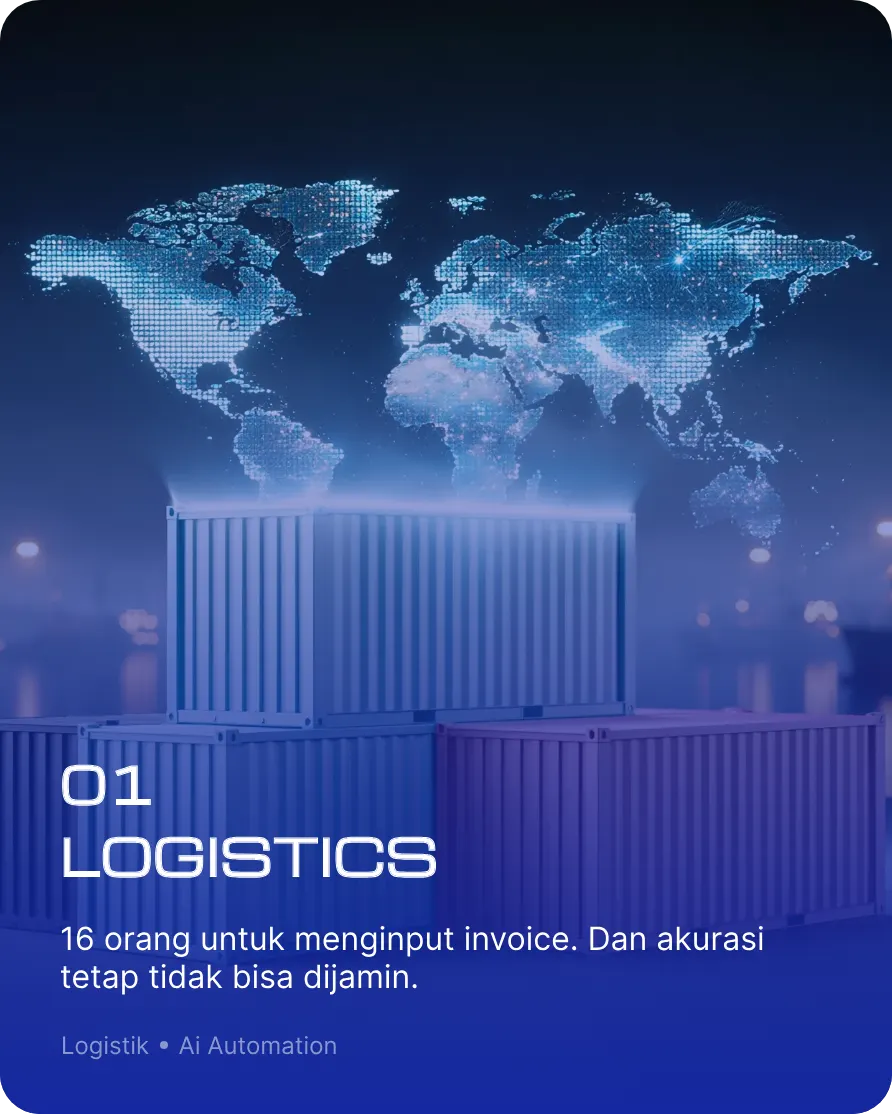
This logistics company processes thousands of invoices and operational documents every day. To handle that volume, they employed 16 people dedicated solely to data entry. With that much volume and a fully manual process, human error wasn't a possibility, it was a certainty.
They had already tried building an AI-based solution before meeting Mantiq. The result: accuracy hovering at 70 to 80 percent. Good enough for a proof of concept, not enough for production.
Solution
Mantiq took a different approach from the previous solution. We built a system based on a visual language model that reads documents the way a human would, not just extracting text. With this approach, document extraction accuracy reached 95 to 98 percent. The model understands inconsistent document structures, formats that vary between vendors, and the context needed to ensure the extracted data is genuinely accurate.
On the backend, the system is validated with a token-saving mechanism that keeps operations lean without ballooning inference costs. Any document with a confidence score below a certain threshold is automatically flagged for human review.
Solution Impact
From 16 employees down to 2.
Operational cost for this function dropped from 80 to 12 million rupiah per month to 20 to 30 million rupiah per month. Savings of up to 82 million rupiah every month, from a single function alone.
Human error in the document input process dropped close to zero. The two remaining employees no longer type in data entry, they supervise the system and handle exceptions that genuinely require human judgment.
Problem Impact
16 data entry employees meant operational spending between 80 and 112 million rupiah per month, for a single function alone. Beyond the cost, input errors that slipped through to downstream systems created a chain reaction of problems: incorrect invoices, delayed reconciliation, and client disputes that should have been avoidable.
The AI solution they had already tried couldn't be relied on because a 20 to 30 percent error rate was still too high at operational scale. That meant the human team still had to double-check every output, which defeated the entire purpose of automation.

In Progress
Problem
This international travel agency used an off-the-shelf ERP that never truly fit their operations. Every time a specific business need came up, the fix wasn't to adjust the ERP, it was to adjust how the team worked. Over the years, they built workaround on top of workaround.
Solution
Mantiq is building a custom ERP designed from the ground up to follow their business processes, not the other way around. Inside this ERP, AI automates the parts that had always been skipped over: invoice data processing and validation, customer service, all the way to cross-divisional operational planning. The result is a system that genuinely works for their business, at an operational cost far lower than off-the-shelf ERP licensing.
Problem Impact
An ERP that doesn't fit isn't just uncomfortable, it slows down the human team's response. Where there shouldn't need to be any, there were invoice-checking staff, customer service handling staff, and operational planning staff whose work still required human intervention. License fees kept getting paid, but the promised efficiency never arrived.
Kami tidak bisa menyebut nama klien kami.
Tapi mereka sangat tahu siapa kami.
Setiap proyek di halaman ini adalah sistem nyata yang berjalan di produksi. Nama dan detail klien tidak kami tampilkan karena ikatan NDA. Yang kami tampilkan adalah masalahnya, pendekatannya, dan hasilnya.
Aktif di Produksi
Masalah
Perusahaan logistik ini memproses ribuan invoice dan dokumen operasional setiap harinya. Untuk menangani volume ini, mereka mempekerjakan 16 orang khusus untuk data entry. Dengan volume sebesar itu dan proses yang sepenuhnya manual, human error bukan kemungkinan, tapi kepastian.
Mereka sudah mencoba membangun solusi berbasis AI sebelum bertemu Mantiq. Hasilnya: akurasi di atas tapi masih 70 hingga 80 persen. Untuk proof of concept, tidak cukup untuk produksi.
Solusi
Mantiq menggunakan pendekatan yang berbeda dari solusi sebelumnya. Kami membangun sistem berbasis visual language model yang membaca dokumen sebagaimana manusia membacanya, bukan sekedar mengekstrak teks. Dengan pendekatan ini, akurasi ekstraksi dokumen mencapai 95 hingga 98 persen. Model ini mampu memahami struktur dokumen yang tidak konsisten, format yang berbeda-beda antar vendor, dan konteks yang diperlukan untuk memastikan data yang diekstrak benar-benar akurat.
Di backend, sistem divalidasi dengan mekanisme penghematan token yang memastikan operasi tetap hemat tanpa biaya inferensi yang membengkak. Setiap dokumen yang memiliki tingkat kepercayaan di bawah threshold tertentu secara otomatis diflag untuk review manusia.
Dampak Solusi
Dari 16 karyawan menjadi 2.
Biaya operasional untuk fungsi ini turun dari 80 juta hingga 12 juta rupiah per bulan menjadi 20 juta hingga 30 juta rupiah per bulan. Penghematan hingga 82 juta rupiah setiap bulan, dari satu fungsi saja.
Human error pada proses input dokumen turun mendekati nol. Dua karyawan yang tersisa tidak lagi mengetikkan data entry, mereka mengawasi sistem dan menangani exception yang memang butuh pertimbangan manusia.
Dampak Masalah
16 karyawan data entry berarti pengeluaran operasional antara 80 juta hingga 112 juta rupiah per bulan, hanya untuk satu fungsi. Di luar biaya, kesalahan input yang lolos ke sistem downstream menciptakan masalah beruntun: invoice yang salah, rekonsiliasi yang molor, dan dispute dengan klien yang seharusnya bisa dihindari.
Solusi AI yang sudah dicoba tidak bisa diandalkan karena 20 hingga 30 persen error masih terlalu tinggi untuk skala operasional. Artinya tim manusia tetap harus memeriksa ulang semua output, yang meniadakan seluruh tujuan otomasi.
Sedang Berjalan
Masalah
Travel agent internasional ini menggunakan ERP off-the-shelf yang tidak pernah benar-benar cocok dengan operasional mereka. Setiap kali ada kebutuhan bisnis yang spesifik, solusinya bukan menyesuaikan ERP, melainkan menyesuaikan cara kerja tim. Selama bertahun-tahun, mereka membangun workaround di atas workaround.
Solusi
Mantiq sedang membangun ERP custom yang dirancang dari nol mengikuti proses bisnis mereka, bukan sebaliknya. Di dalam ERP ini, AI mengotomasi bagian-bagian yang selama ini dilewatkan: pemrosesan dan validasi data invoice, customer service, hingga perencanaan operasional lintas divisi. Hasilnya adalah sistem yang benar-benar bekerja untuk bisnis mereka, dengan biaya operasional yang jauh lebih rendah dibanding lisensi ERP pasar.
Dampak Masalah
ERP yang tidak fit bukan sekedar tidak nyaman, ia memperlambat respon tim manusia. Di mana seharusnya tidak ada, staf pemeriksaan invoice, staf penanganan customer service, hingga staf perencanaan operasional yang kinerjanya masih butuh intervensi manusia. Biaya lisensi terus dibayar, tapi efisiensi yang dijanjikan tidak pernah datang.